How to Identify Lawn Weeds by Photo (with a Common-Weed ID Chart)
There's a weed in your lawn. You don't know its name — and you can't treat it until you do, because the stuff that kills clover won't touch crabgrass, and nothing labeled "broadleaf weed killer" will faze a grassy weed. So you do what everyone does now: pull out your phone and try to identify it from a photo.
Here's how to do that well — how to take a photo that actually leads to a correct ID, the five features that give a weed away, and a chart of the most common lawn weeds so you can match what you see.
Start Here: The 3 Types of Lawn Weeds
Every lawn weed falls into one of three groups, and knowing the group is half the battle:
- Broadleaf weeds have wide, flat leaves that look nothing like grass — dandelion, clover, creeping Charlie, plantain.
- Grassy weeds look just like grass blades and blend into your lawn — crabgrass, quackgrass, foxtail, annual bluegrass.
- Sedges look grass-like but have triangular stems — yellow nutsedge is the big one.
How to Take a Photo That Actually Identifies a Weed
Most failed IDs come down to a bad photo, not a hard weed. Whether you're using a search engine, an ID app, or asking a neighbor, the photo makes or breaks the answer. Here's how to shoot a good one:
- Fill the frame with one weed. Get close and isolate a single plant — don't shoot a whole patch, or the detail gets lost.
- Use daylight, no flash. Natural light shows the true color. Avoid harsh shadows falling across the plant.
- Capture the leaf and the stem base. The stem tells you a lot — round means grass, triangular means sedge. Get both in frame, or take a second shot of the base.
- Include any flower or seed head. This is the single fastest ID signal — a fox-tail seed head, a dandelion puffball, or a clover bloom can clinch it.
- Hold steady so it's sharp. Blur is the number-one reason an ID fails. Brace your elbow or rest your phone on something.
- Take two or three angles. A top-down shot plus a side shot captures both the leaf pattern and how the plant grows.
Let the Photo Do the Work
Once you've got a sharp, close-up shot, you can let an app name it for you. Grass Identifier is built specifically for lawns — point your camera at the weed and it names the species and gives care tips for that exact plant. Free to download on iPhone and Android.
The 5 Features That Give a Weed Away
When you look at your photo — or the weed itself — these five features narrow it down fast:
- Leaf shape. Wide and flat (broadleaf), thin blades (grassy), or glossy and stiff (sedge)?
- Stem. Round or flat (grass), square (mints like creeping Charlie), or triangular (sedge)?
- Growth habit. Does it sprawl flat, grow in a clump, creep along the ground, or stand upright?
- Flower or seed head. Its color, shape, and timing — often the fastest giveaway.
- Season. When did it appear? Crabgrass shows up in summer heat; annual bluegrass in cool spring.
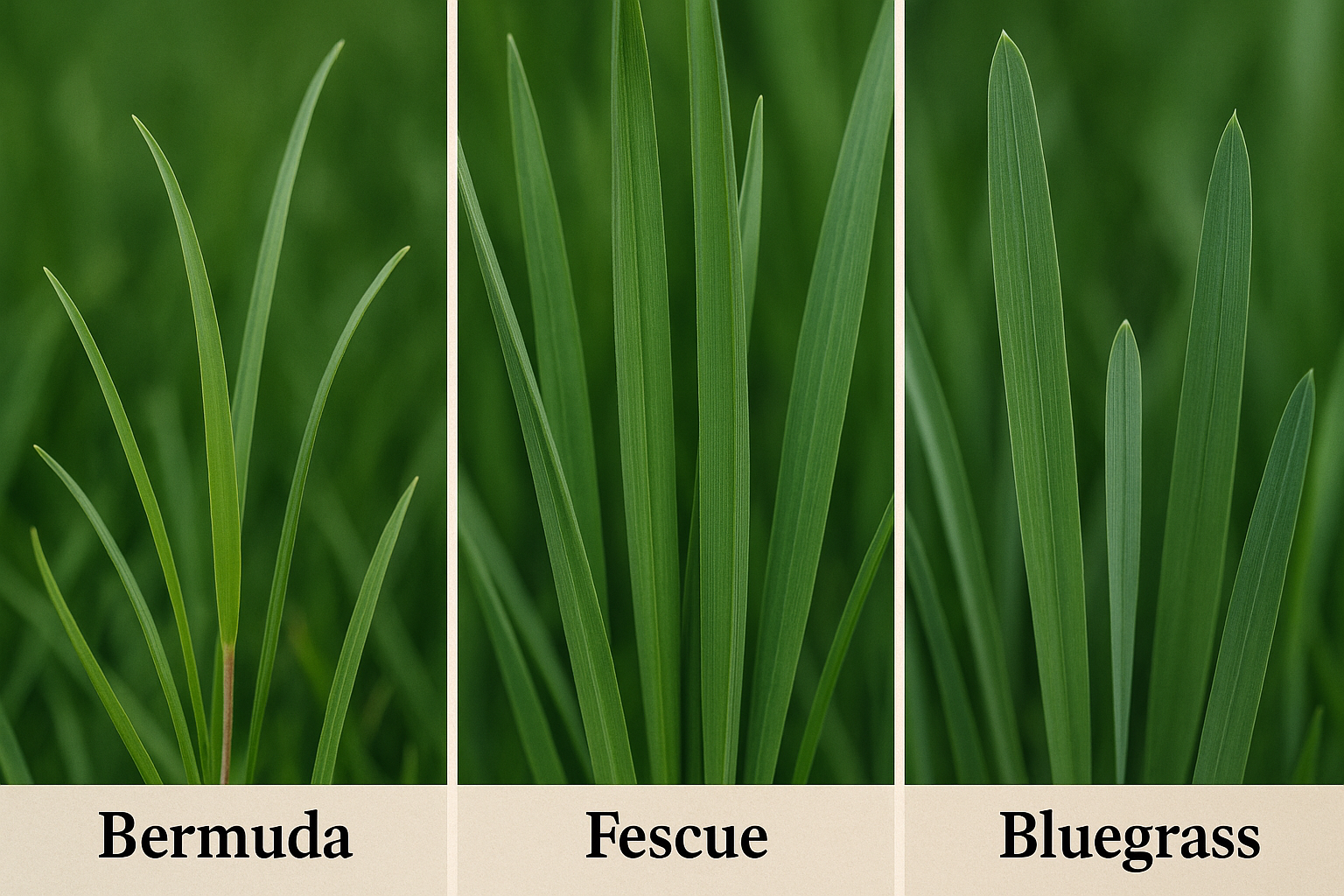
Common Lawn Weed ID Chart
Match what you see against the weeds that show up most often:
| Weed | Type | One-glance signal | When |
|---|---|---|---|
| Dandelion | Broadleaf | Jagged toothed leaves; yellow bloom to puffball | Spring–fall |
| White clover | Broadleaf | Three leaflets with a pale crescent; round white flower | Spring–summer |
| Creeping Charlie | Broadleaf | Round scalloped leaves; square stem; purple flowers | Spring |
| Oxalis (wood sorrel) | Broadleaf | Heart-shaped clover-like leaves; small yellow flowers | Spring–fall |
| Plantain | Broadleaf | Oval ribbed leaves in a flat rosette | Spring–fall |
| Chickweed | Broadleaf | Small teardrop leaves; tiny white star flowers | Cool season |
| Crabgrass | Grassy | Flat star sprawl; wide pale blades | Summer |
| Goosegrass | Grassy | Silvery center; wheel-spoke seed heads | Summer |
| Annual bluegrass | Grassy | Boat-shaped tip; pale low seed heads | Spring |
| Quackgrass | Grassy | Clasping auricles on the stem | Spring–fall |
| Yellow nutsedge | Sedge | Triangular stem; outgrows the lawn fast | Summer |
If your weed looks a lot like your actual grass — the ones that hide in the lawn instead of standing out — go deeper with our guide to the 11 weeds that look like grass.
Frequently Asked Questions
Can I identify a weed just from a photo?
Often, yes — if the photo is clear and shows the leaf, the stem, and any flower or seed head. A sharp, well-lit close-up of a single plant gives you (or an ID app) the detail needed to name most common lawn weeds. Blurry or far-away shots are where it falls apart.
How do I take a good photo to identify a weed?
Get close and fill the frame with one plant, shoot in daylight without flash, capture both the leaf and the stem base, include any flower or seed head, hold steady for a sharp image, and take two or three angles.
What are the three types of lawn weeds?
Broadleaf weeds (wide flat leaves, like dandelion and clover), grassy weeds (blade-like, blend into the lawn, like crabgrass), and sedges (grass-like with triangular stems, like nutsedge). Each one needs a different treatment.
What is the most common weed in lawns?
Crabgrass and dandelion are the two most common across the US, followed by clover, nutsedge, and annual bluegrass. The exact mix depends on your region, your grass type, and how the lawn is mowed and watered.
Is there a free app to identify weeds by picture?
Several photo ID apps exist. Grass Identifier is free to download on iPhone and Android and is built specifically for lawns, so it names the species and gives care tips for your yard rather than treating it like any houseplant. If your focus is the lawn, that's the difference that matters.
How accurate is photo weed identification?
It has gotten good, but it isn't perfect — and accuracy depends almost entirely on your photo. A sharp, close, well-lit shot that shows the leaf, stem, and seed head gives a reliable answer, while a blurry or distant photo can be misread. For weeds that are hard to tell apart, take a few angles and double-check against a chart.
Why do I need to identify a weed before treating it?
Because weed killers are selective. A broadleaf herbicide won't touch grassy weeds or sedges, and a product made for nutsedge won't kill crabgrass. Treat without identifying and you'll likely waste money and time — and maybe stress your lawn — without killing the weed. Name it first, then match the treatment.
The Bottom Line
You can't fix what you can't name. A clear photo — close, well-lit, and showing the leaf, stem, and seed head — is the difference between a confident ID and a guess. Sort the weed into one of the three types, check the five features, match it against the chart, and you'll know what you're dealing with.
And when you'd rather skip the detective work, that's exactly what Grass Identifier is for: snap the photo, get the species name and lawn-care tips in one place. Free to download on iPhone and Android. 🌿