What Type of Grass Do I Have? The Ultimate Identification Guide
So you're standing in your yard, staring at the green stuff under your feet, and thinking... what actually is this?
You're not alone. "What type of grass do I have?" is hands-down the most common question I get from neighbors, friends, and pretty much anyone who finds out I'm into lawn care. And honestly, it's the most important question you can ask about your lawn.
Here's why: everything about lawn care depends on knowing your grass type. When to water, how short to mow, when to fertilize, whether those brown patches are normal or a five-alarm emergency. It all comes back to what's actually growing in your yard.
So let's figure it out.
Warm-Season vs. Cool-Season: The First Big Question
Before we get into specific grass types, you need to answer one thing: do you have a warm-season grass or a cool-season grass?
This is the single biggest dividing line in the grass world, and it'll narrow things down fast.
Cool-season grasses love temperatures between 60°F and 75°F. They grow like crazy in spring and fall, and they stay green through mild winters. You'll mostly find them in the northern half of the US, think anywhere that gets real winters.
Warm-season grasses thrive in heat, usually between 80°F and 95°F. They go all-out in summer and go dormant (turn brown) in winter. These are your southern and transitional zone grasses.
Here's the quick test: Does your lawn turn brown and go dormant in winter? If yes, you've probably got a warm-season grass. If it stays green most of the year (even if it slows down), lean toward cool-season.
The Quick Decision Tree
Before we dive deep, here's a fast way to start narrowing things down. Grab a handful of your grass and take a close look:
Blade shape:
- Very fine, almost needle-like → Probably Fine Fescue or Bermuda Grass
- Medium width with a boat-shaped tip: Likely Kentucky Bluegrass
- Wide, flat blades with a rounded tip: Could be St. Augustine or Tall Fescue
- Folded blades that are stiff to the touch: Might be Zoysia
- Spreads by above-ground runners (stolons): St. Augustine, Bermuda, or Centipede
- Spreads by underground runners (rhizomes): Kentucky Bluegrass or Bermuda
- Grows in bunches/clumps: Tall Fescue, Ryegrass, or Fine Fescue
- Dark green, almost blue-green: Kentucky Bluegrass or Ryegrass
- Bright, lime-green: St. Augustine or Centipede
- Medium green with a grayish tint: Bermuda or Zoysia
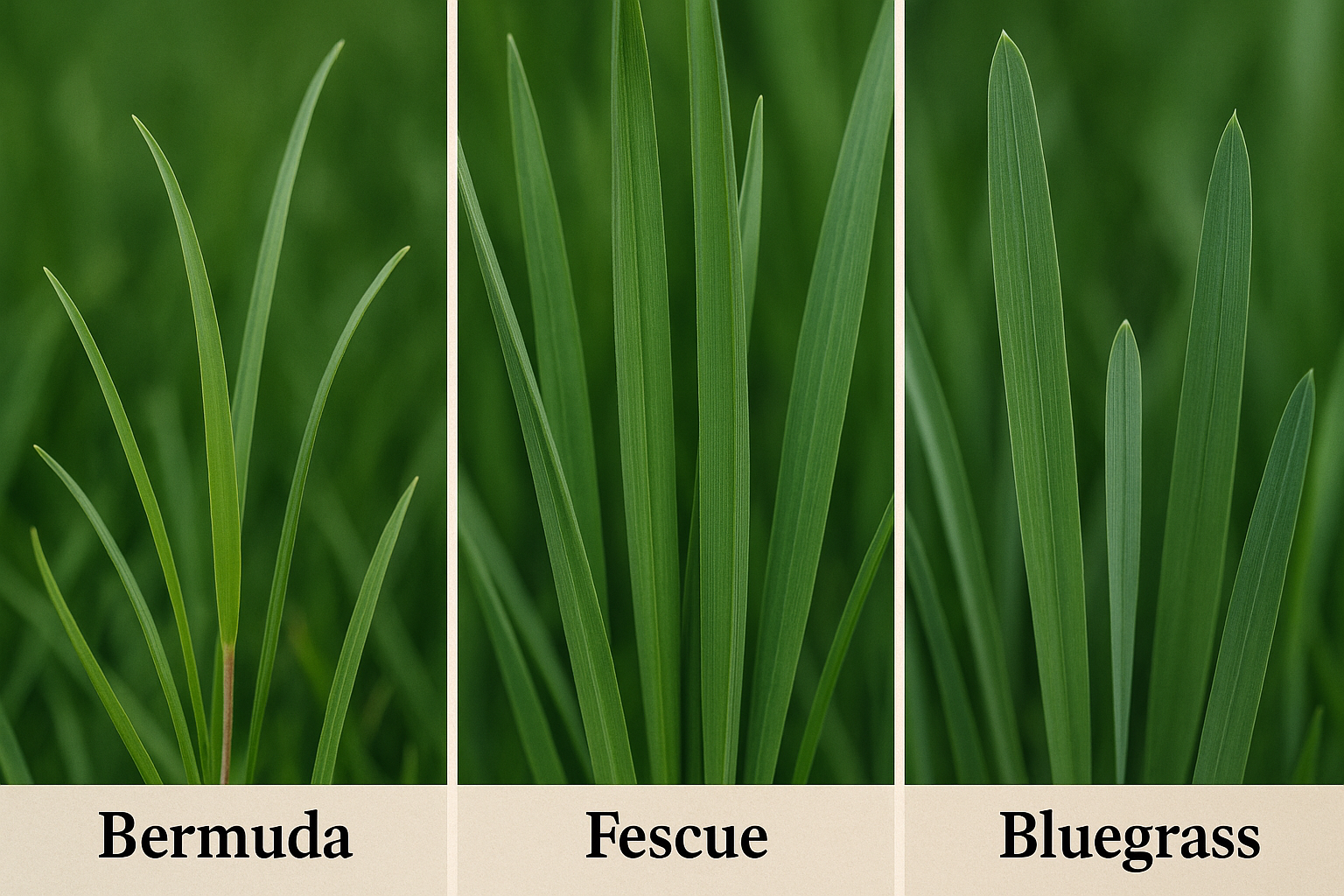
The 10 Most Common Lawn Grasses
1. Kentucky Bluegrass
The classic American lawn grass. If you live anywhere in the northern US and your lawn looks like a golf course (or you wish it did), there's a solid chance you've got Kentucky Bluegrass.
How to spot it:
- Medium-width blades with a distinctive boat-shaped tip (the blade tip looks like the bottom of a canoe)
- Rich, dark green to blue-green color
- Spreads by rhizomes (underground runners), so it fills in bare spots on its own
- Very soft underfoot. This is the grass you want to walk barefoot on
The catch: It needs more water and maintenance than most grasses. But man, when it's dialed in, nothing looks better.
2. Bermuda Grass
The king of warm-season lawns. Bermuda is tough, aggressive, and loves the heat. If you're in the south and your lawn is dense and low-growing, this is your top suspect.
How to spot it:
- Fine to medium-width blades
- Grows very dense and low to the ground
- Has both stolons (above-ground runners) AND rhizomes (underground runners). This stuff spreads everywhere
- Light to medium green color
- Turns straw-brown in winter dormancy
Fun fact: Bermuda can handle being mowed insanely low (like half an inch) and still bounce back. That's why it's the go-to for sports fields.
3. Tall Fescue
The tough, low-maintenance cool-season option. Tall Fescue is the grass for people who want a nice lawn without babying it every weekend.
How to spot it:
- Wide, coarse blades with visible veins running parallel
- Grows in clumps (bunch-type growth), not runners
- Dark green color
- Rough texture. You can feel the difference compared to Bluegrass
Why people love it: Deep roots, drought tolerant, shade tolerant, disease resistant. It's the reliable friend of the grass world.
4. Perennial Ryegrass
The fast-germination champion. Ryegrass is often mixed with other grasses because it germinates in 5-7 days (compared to 2-3 weeks for Bluegrass). It's the quick fix of lawn grasses.
How to spot it:
- Fine to medium blades with a glossy sheen on the underside
- Dark green, almost emerald color
- Bunch-type growth (no runners)
- Has a distinctive fold down the center of each blade
5. Fine Fescue
The shade specialist. If you've got trees and your lawn still looks decent underneath them, Fine Fescue is probably doing the heavy lifting.
There are actually several types (Creeping Red, Chewings, Hard, and Sheep Fescue), but they share key traits:
How to spot it:
- Very fine, needle-like blades, the thinnest of any common lawn grass
- Medium to dark green
- Soft, dense growth that feels great underfoot
- Grows in clumps or spreads slowly via rhizomes
6. St. Augustine Grass
The thick, tropical-looking lawn grass. If you're in Florida, along the Gulf Coast, or in southern California, and your lawn has those wide, flat blades, that's St. Augustine.
How to spot it:
- Very wide, flat blades with rounded tips, the widest blades of any common lawn grass
- Coarse texture
- Dark green to bright green
- Spreads by thick, above-ground stolons
- Creates a very dense, carpet-like lawn
Heads up: St. Augustine can't be bought as seed. It's always planted as sod or plugs.
7. Zoysia Grass
The slow-and-steady luxury grass. Zoysia is the grass that takes forever to establish but creates an incredibly dense, carpet-like lawn once it fills in.
How to spot it:
- Fine to medium blades that feel stiff and wiry to the touch
- Grows extremely dense, so thick that weeds can barely push through
- Medium green, sometimes with a slight straw color
- Spreads by both stolons and rhizomes (but slowly)
- Turns golden-brown in winter
8. Centipede Grass
The lazy person's grass (and I mean that as a compliment). Centipede is the lowest-maintenance warm-season grass you can grow. It's for folks who want a decent lawn without doing much.
How to spot it:
- Medium-width blades
- Light, apple-green color (noticeably lighter than Bermuda or Zoysia)
- Slow-growing with above-ground stolons
- Moderate density
The deal: Centipede doesn't want to be fertilized much. Over-fertilizing is actually one of the fastest ways to kill it.
9. Bahia Grass
The tough survivor for sandy soils. Bahia is common in Florida and the deep south, especially in areas with poor, sandy soil where other grasses give up.
How to spot it:
- Coarse, flat blades that are tough and leathery
- Light to medium green
- Grows in a distinctive "V" pattern from the crown
- Sends up tall, Y-shaped seed heads that stick up above the lawn
10. Buffalo Grass
The native prairie grass turned lawn option. Buffalo Grass is actually native to the Great Plains and is becoming more popular as people look for ultra-low-water lawn alternatives.
How to spot it:
- Fine, curling blades that are soft and gray-green
- Grows low and thin compared to other lawn grasses
- Spreads by stolons
- Goes dormant and turns tan from fall through spring
Still Not Sure What You've Got?
Look, I get it. Reading descriptions can only get you so far. Grass identification is honestly one of those things where a picture is worth a thousand words.
If you're still scratching your head, try snapping a photo with the Grass Identifier app. You just point your camera at your grass, and it tells you what species it is, plus all the care info you need. I use it myself when I run into something unusual. It's genuinely handy.
Tips for Getting a Good ID
Whether you're using an app, asking an expert, or trying to figure it out yourself, here are some tips:
- Look at the blade tip. Boat-shaped? Pointed? Rounded? This is one of the most reliable ID features.
- Check how it spreads. Pull up a small section and look for runners above or below the soil line. Bunch-type vs. spreading grasses are easy to tell apart.
- Feel the texture. Roll a blade between your fingers. Is it soft and smooth? Stiff and wiry? Rough and coarse?
- Note the color. Not just "green." Is it dark green, blue-green, lime green, gray-green?
- Look at the seed head if it's growing long. Each grass type has a distinctive seed head shape.
- Consider your location. If you're in Minnesota, you probably don't have Bermuda. If you're in Florida, you probably don't have Kentucky Bluegrass. Geography narrows things down fast.
Why It Actually Matters
I know some people think, "It's grass. It's green. Who cares what type it is?"
Well, here's the thing. If you've got Kentucky Bluegrass and you're fertilizing it in summer, you're burning it. If you've got Bermuda and you're mowing it at 4 inches, it's going to look terrible. If you've got Fine Fescue and you're overwatering it, you're inviting disease.
Knowing your grass type is the difference between a lawn that thrives and one that just barely survives.
So take five minutes, go look at your lawn, and figure out what you're working with. Your grass will thank you.
And if you want to make it really easy, grab the Grass Identifier app. Snap a photo and you'll know in seconds. Then come back here and read up on exactly how to take care of what you've got.
Happy growing. 🌱